
Local Blue Economy Growth Fund
| Call for applications is now open. Application deadline is 5:00 PM ET Friday, November 13, 2026. Download the LBEGF Application Package. |
 |
 |
|
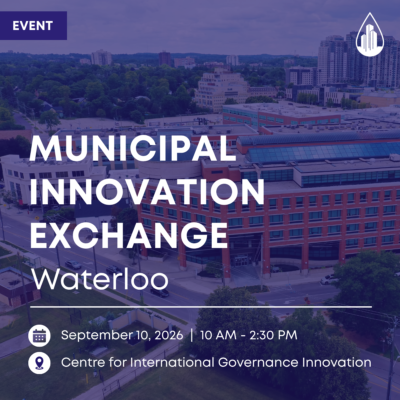
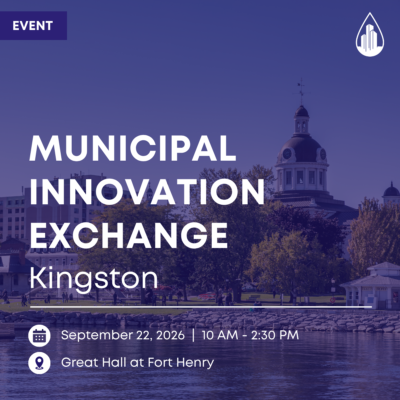
Municipal Innovation Exchange events create space for cross-sector and cross-jurisdictional dialogue on water quality and quantity challenges facing Ontario communities. Bringing together municipal leaders, stormwater and wastewater professionals, First Nations, researchers, industry leaders, technology innovators, and government partners, these events connect the people shaping the future of freshwater in the Great Lakes and St. Lawrence River Region. |
|
Funding for Innovative Stormwater and Wastewater Solutions
Helping municipalities and Indigenous communities improve water quality and build climate resilience.
Persistent and emergent pressures on water quality from extreme weather events, community growth, and legacy and emerging contaminants across the Great Lakes and St. Lawrence River Region are intensifying and outpacing the capacity of municipalities and other organizations to effectively protect infrastructure and maintain water quality.
The Great Lakes and St. Lawrence Cities Initiative (“Cities Initiative”) has launched the Local Blue Economy Growth Fund Program (LBEGF) to support Cities Initiative member municipalities and First Nations communities in Ontario with project-based funding for green infrastructure, innovative water management technologies, and low impact development solutions to stormwater and wastewater management. This program will lay the foundation for advancing the Cities Initiative’s Economic Transformation Action Plan to build a stronger, more resilient Fresh Coast Economic Corridor.
Expected Outcomes
Projects funded by the Local Blue Economy Growth Fund are expected to promote healthy lakes and rivers, reduce water pollution and improve water quality, and strengthen community climate resilience, while contributing to the growth of Ontario’s freshwater blue economy through the adoption of innovative water technology solutions.
Funding Snapshot
| Total funding available: | $1,000,000 |
| Maximum funding amount per project: | $50,000 |
| Minimum funding amount per project: | $5,000 |
| Required matching funds: | Communities with populations greater than 250,000 must provide at least 20% matching funds (cash or in kind) to be eligible. |
| Project duration: | Application intake 1: 16 months Application intake 2: 11 months |
| Project completion: | All projects must be completed and final reports submitted by 11:59 PM ET December 31, 2027. |
Who is eligible to apply?
Applicants must meet all the following eligibility requirements:
- Be located in Ontario
- Be a municipal government or First Nations community
- Be a member in good standing of the Cities Initiative as of the date of application
Note: Regional Affiliates (i.e., lower tier municipalities of a county or regional municipality that is a member) are not eligible to apply unless they are themselves a member in good standing of the Cities Initiative. If you’re unsure about your organization’s eligibility, contact us at lbegf@glslcities.org.
The applying organization must have primary responsibility for overseeing, managing, and delivering the project.
What projects are eligible for funding?
Proposed projects must focus on one or more of the following activities with the goal of promoting healthy lakes and rivers, improving water quality, and/or strengthening community climate resilience:
- Pollution capture and contaminant removal
- Stormwater and wastewater treatment and filtration
- Smart and innovative technology solutions for stormwater management
- Circular economy and resource recovery practices
- Nature-based and green stormwater infrastructure
Ineligible Projects
Projects that focus on the following are ineligible for funding:
- Drinking water
- Community engagement
- Shoreline stewardship
- Ecosystem restoration
Eligible Costs
Eligible costs are those that are reasonable, necessary, and directly related to the delivery of approved project activities. Costs are considered eligible only if they are incurred on or after the effective date of the funding agreement and no later than the date of submission of the final report.
All costs must be supported by appropriate documentation and are subject to review by the Cities Initiative. The following are considered eligible costs:
- Technology and equipment costs (for the length of the funding agreement)
- Professional and contracted services (for the length of the funding agreement)
- Staffing and personnel costs (up to 10% of the total grant amount)
- Materials and supplies, including printing and promotional materials
Ineligible Project Costs
- Costs incurred prior to the effective date of the funding agreement
- Costs incurred after the submission of the final report
- Overhead and core administrative costs (e.g., rent)
- Insurance
- Capital expenses related to the purchase, construction, or betterment of tangible capital assets for use in the organization’s operation on a continuous basis
- Land securement
- Clothing
- Appreciation gifts
- Honoraria other than for Indigenous Elders or community knowledge holders
- Refundable harmonized sales tax (HST)
- Legal costs (including but not limited to litigation)
Please note the above list is not exhaustive. If you are unsure about cost eligibility, contact us.
Attend a virtual information session
The Cities Initiative will hold two (2) virtual information sessions, one for each application intake, to help eligible applicants prepare for upcoming application deadlines. These virtual information sessions will include details about the program, the funding available, the eligible project types and costs, and tools and guidance on preparing a strong application.
| Intake 1 – Virtual Information Session | 2:00 PM ET Thu, May 28, 2026 | Passed |
| Intake 2 – Virtual Information Session | 2:00 PM ET Thu, Oct 8, 2026 | Register |
Office Hours
The Ontario Program Manager for the Cities Initiative, Calantha Elsby, will host drop-in office hours every Monday, Wednesday, and Friday from June 3 to 24 and October 21 to November 12, between 1:00 – 4:30 PM for eligible applicants seeking support with their applications. Applicants will be able to book a 15-minute time slot to discuss their project and receive guidance on their application. Book your office hours timeslot.
How to apply
There will be two application intake deadlines: Fri, Jun 19, 2026 and Fri, Nov 13, 2026.
All applicants must submit a completed application package to lbegf@glslcities.org by the deadline to be considered for funding. Incomplete applications or applications submitted after the deadline will not be considered.
Application Deadlines
| Call for applications | Thu, May 7, 2026 |
| Intake 1 – Application deadline | 5:00 PM ET Fri, Jun 19, 2026 |
| Intake 2 – Application deadline | 5:00 PM ET Fri, Nov 13, 2026 |
Download the application package
The provided application package includes the following:
- Grant guidelines (PDF)
- Application questions worksheet (DOC) to help you prepare your final application.
- Final Application (PDF) that must be submitted alongside the supporting documents.
- Supporting documents templates (XLSX) which includes the project budget, workplan, cashflow forecast, and performance measures templates.
Submit your completed application package to lbegf@glslcities.org.
| Download the LBEGF Application Package. |
Key Dates
Sign up to receive updates and reminders about upcoming deadlines, virtual information sessions, and program announcements.
| Call for applications | Thu, May 7, 2026 |
| Intake 1 – Virtual information session | Thu, May 28, 2026 |
| Intake 1 – Application deadline | 5:00 PM ET Fri, Jun 19, 2026 |
| Intake 2 – Virtual information session | Thu, Oct 8, 2026 |
| Intake 2 – Application deadline | 5:00 PM ET Fri, Nov 13, 2026 |
| Project Completion and Final Report Submission Deadline | 11:59 PM ET Dec 31, 2027 |
Contact
If you have any questions, contact Calantha Elsby, Ontario Program Manager, at lbegf@glslcities.org.
Acknowledgment
This project has received funding support from the Government of Ontario. Such support does not indicate endorsement by the Government of Ontario of the contents of this material.
News
August 27, 2026 — Join us at an upcoming Municipal Innovation Exchange in Waterloo or Kingston. Municipal Innovation Exchange (MIX) events create space for cross-sector and cross-jurisdictional dialogue on water quality and quantity challenges facing Ontario communities… [Continue reading]
–
August 8, 2026 — Download:16 Cutting-edge Water Tech Startups with Innovative Solutions for Ontario Communities. Discover innovative solutions to stormwater and wastewater management challenges to support your application to the Local Blue Economy Growth Fund… [Continue reading]
–
July 3, 2026 — Partner Content: Tackling Blue-Green Algae: From Prevention to Action. As cyanobacterial blooms affect a growing number of water bodies, municipalities are facing increasingly important challenges, including protecting drinking water intakes… [Continue reading]
–
June 8, 2026 — Water-Tech Startups Showcase Solutions to Municipal Water Challenges at Nexus H2O. As part of the Local Blue Economy Growth Fund’s (LBEGF) knowledge mobilization program, the Cities Initiative partnered with AquaAction to deliver Nexus H2O… [Continue reading]
–
June 5, 2026 — Ontario Communities and Water-Tech Innovators Connect to Tackle Emerging Water Quality Challenges. At the first Local Blue Economy Growth Fund Municipal Innovation Exchange, municipal staff, mayors, and industry leaders gathered to discuss… [Continue reading]
FAQ
Can an organization submit more than one application per intake?
Yes–as long as each project submission is distinct from the other. In other words, a single organization can submit more than one application for two separate projects.
What are some examples of projects that would be eligible for funding?
Below is a non-exhaustive list of example projects. If you are unsure whether your project is eligible, please contact us at lbegf@glslcities.org.
- Pollution capture and contaminant removal: Catch basin inserts, oil and grit separators, sediment traps.
- Stormwater and wastewater treatment and filtration: Membrane filtration, membrane bioreactors, biofilters.
- Smart and innovative technology solutions for stormwater management: IoT sensors, digital twinning, predictive analytics and machine learning systems.
- Circular economy and resource recovery practices: Greywater reuse systems, nitrogen recovery systems, two-pass reverse osmosis.
- Nature-based and green stormwater infrastructure: Rain gardens, bioswales, infiltration trenches, green curbside systems.
How will projects be evaluated?
Projects will undergo a three-stage evaluation process:
- An administrative review
- A technical review
- An internal review
You can find details for each in the Application Guidelines.
Are monitoring projects eligible?
Stand-alone monitoring projects are not eligible. Monitoring can be funded as part of a broader project (e.g., monitoring of the effectiveness of the new technology implemented) or a monitoring project can be used as a matching contribution so long as it relates to the proposed project and its desired outcomes.
Can other external funds be used as matching contributions?
Yes—other funds you’ve received from other sources can be used as matching contributions, so long as the LBEGF funds are not being applied to project elements that are otherwise funded.
Does the proposed technology or approach need to be novel overall or is it sufficient for it to be new to the applying organization?
The proposed technology or approach should be new to the applying organization.
How much money is available for each intake?
There is $1 million available across both intakes. While there is no set amount distributed to each intake, efforts will be made to award an equal number of projects across both.