
Archive
Cities Initiative’s Ullrich Featured on Areas of Concern Panel
Leave a CommentGreat Lakes and St. Lawrence Cities Initiative Executive Director, Dave Ullrich, along with Wendy Carney of the U.S. Environmental Protection Agency, Chris McLaughlin of the Bay Area Restoration Council, and Jon Gee of Environment and Climate Change Canada were featured on a panel about the Great Lakes Areas of Concern on TVOntario's The Agenda with Steve Paikin at the Great Lakes Public Forum in Toronto, Ontario. With only seven out of 43 ares of concern removed after about 30 years, the panel discusses the progress and future of work related to Areas of Concern in the U.S. and Canada.
“The number one Area of Concern problem has been contaminated sediments from the very beginning” said Ullrich. “With industrial discharges over many, many years a lot of contaminants, particularly PBCs, or polychlorinated biphenyls, have wound up in those sediments.”
Ullrich also went on to tell the story and mission of the Cities Initiative, specifically how it was born out of a desire for cities to have a seat at the Great Lakes/St. Lawrence decision-making table. To watch the panel, see the video below. For more information on the panel, click here.
Duluth’s Mayor Larson Joins Cities Initiative Board of Directors
Leave a CommentThe Great Lakes and St. Lawrence Cities Initiative (Cities Initiative) is proud to announce the newest member of the Board of Directors, Mayor Emily Larson of Duluth, Minnesota. Mayor Larson will be joining as the 16th member of the Board. As a prominent shipping port and the second-largest city on Lake Superior, the City of Duluth’s voice will be a vital asset to the Board of Directors.
“I look forward to Mayor Larson’s contribution to the Board,” said Mayor Denis Coderre, chair of the Cities Initiative Board of Directors and Mayor of Montreal. “Her commitment to the Great Lakes and unique regional perspective will continue to help our organization grow.”
In her time as a Duluth City Council President prior to becoming Mayor, Larson championed numerous parks and trails, advised the inception of the Duluth Energy Efficiency Program, and served on the board for the Great Lakes Aquarium. Since winning the mayoral election in 2015, Mayor Larson committed to re-establishing Duluth’s Environmental Advisory Council and invested $500,000 in energy efficiency programs. Mayor Larson has demonstrated leadership and vision in addressing Duluth’s environmental issues, a valuable addition to the Cities Initiative Board.
“I am pleased to continue the tradition of Duluth representing the needs of Great Lakes cities. I look forward to being a partner and advocate for the conservation of our precious resource,” said Mayor Larson.
The Great Lakes and St. Lawrence Cities Initiative is a coalition of over 120 cities from the United States and Canada representing over 17 million people who work together for the long term protection and restoration of the resource. With the addition of Mayor Larson, the Board looks forward to a prosperous year of protecting the Great Lakes and St. Lawrence River.
Cities Initiative Exec. Director talks Urban-Rural Partnerships
Leave a CommentCities Initiative Executive Director David Ullrich spoke at the Michigan Water Symposium on January 14, 2016. In his interview with Kirk Heinze of MLive, Ullrich discussed his experiences at the Paris Climate Summit for Local Leaders in early December and the importance of collaborative work between urban and rural stakeholders, saying, “there is a natural partnership between urban and rural communities.”
What It’s Like to be in a Room with 446 Mayors: Dave Ullrich on COP21
Leave a Comment“The best time to plant a tree is 20 years ago, and the second best time is now.” – Chinese Proverb
The 21st Conference of the Parties on Climate Change was held in Paris in December 2015. Among the activities scheduled was the Climate Summit for Local Leaders, which gathered mayors and other representatives of local governments from all around the world. Why? Not only because cities hold over the half of the Earth’s population and produce 70% of total greenhouse gas, but also because they are a central part of the solution.
On December 4th, 2015, representatives from over 640 cities across 115 countries, including 446 mayors, attended this event, which was hosted by the Mayor of Paris, Anne Hidalgo, and Special Envoy for Cities and Climate Change and former mayor of New York, Michael Bloomberg. Mitch Twolan, Cities Initiative Chair and Mayor of Huron-Kinloss, ON and David Ullrich, Cities Initiative Executive Director, both represented the 119 members of GLSLCI. Member mayors George Heartwell (Grand Rapids), Denis Coderre (Montreal), John Tory (Toronto) and Roger Anderson, Regional Chair of Durham Region, were also present.
-

- Paris City Hall
-

- President Francois Holland (France)
-

- 446 local leaders unite on climate action
Mayor Bloomberg opened the conference by saying that the “attendees were there not to make history, but to shape the future”. He stated that Mayors have the authority to act; that they should act; and that national governments must recognize mayors’ role in making change. The speakers showed that mayors are taking action: The City of Los Angeles plans to be off coal by 2025; Bordeaux brings nature into its urban fabric; Vancouver hopes to rely on 100% renewable energy by 2050; Berlin is banning high-emission vehicles in the central city; and Mexico invests 10% of its budget in the environment.
During this conference, national leaders spoke to the assembly about actions taken at the highest levels of government. The French President François Hollande announced that France is increasing its climate funding contributions from $2 billion per year to $5 billion, and the Chinese government’s special envoy spoke about the nation’s 5 year plan to reduce its use of coal by 20%.
Other influential speakers added their voice to those of the elected officials. Actor and Philanthropist Leonardo DiCaprio urged local leaders not to wait for central governments before taking action, and Robert Redford added that mayors are closer to the issues, people and climate change. He hopes that climate change will become less politicized and that artists will take the opportunity to illustrate this pressing issue. Thomas Bach, President of the International Olympic Committee, highlighted that the Olympic Games can catalyze sustainability in host cities. The CEO of Unilever underlined that the cost of inaction exceeds the cost of action, and Former Vice President Al Gore announced that the use of solar energy has increased globally by 78% in the past year.
-

- Robert Redford speaks
-

- Leonardo DiCaprio speaks
-

- Mayor Anne Hidalgo with local leaders and the Paris City Hall Declaration
Despite an optimistic tone, speakers agreed that needs are tremendous. Globally, an investment of $100 billion per year is required by 2020 in order to achieve these ambitious goals. Cities need to be empowered to be flexible and also need access to financing. Former Vice President Gore emphasized that cities deserve a seat at the table and need to lead by example – these guiding principles are those that the Cities Initiative shares. Cities will need to work in community and collaboration with many stakeholders, including the private sector. Overall, solidarity in action will be necessary.
The summit was punctuated by the adoption of the Paris City Hall Declaration, which expressed city leaders’ commitment to fighting climate change and called for an ambitious agreement among nations.
Great Lakes-St. Lawrence Municipalities Act on Climate Change
Leave a CommentOver the past few months, Cities Initiative staff have inventoried action on climate change by member municipalities in the Great Lakes-St. Lawrence Region.
Of our 119 members:
- 73 are taking action on climate change in some way
- 31 have implemented greenhouse gas reduction targets
- 17 have joined the Compact of Mayors, an international effort for local greenhouse gas reductions.
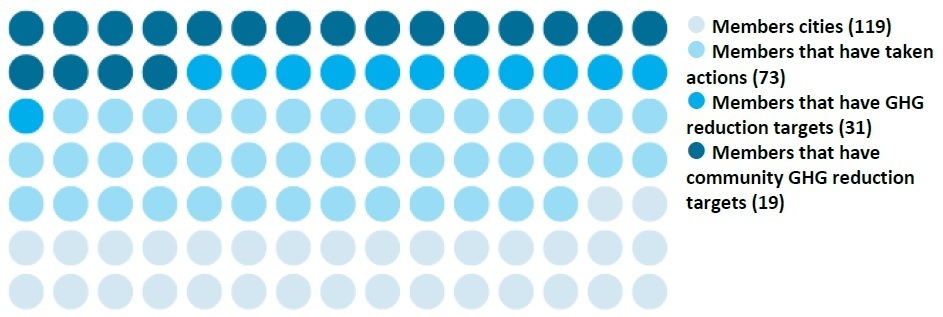
When combined, the 31 cities with greenhouse gas reduction targets have reduced carbon dioxide emissions by over 27 million tons of CO2.
Fact Sheets
- 1-page summary of greenhouse gas reduction targets in member municipalities
- Full inventory of greenhouse gas reduction targets in member municipalities (11 pages)
Fast Facts on Climate Change
If your municipality is considering creating a climate change adaptation or mitigation plan, visit the Best Practices Library and select “Climate Adaptation Plans” to view plans from other municipalities.
Cities lead on climate action, GLSLCI partners with Compact of Mayors
Leave a CommentThe Cities Initiative is excited to partner with the Compact of Mayors, an organization created by Former Mayor Michael Bloomberg of New York City, who serves as a Special Envoy for Cities and Climate Change for the Secretary-General of the United Nations. The Compact demonstrates local government leadership in addressing greenhouse gas emissions in the Great Lakes – St. Lawrence region and around the world. Eleven Cities Initiative members have already committed to the Compact of Mayors, and in addition, as part of this partnership, Executive Director David Ullrich and Board Chair Mitch Twolan, Mayor of Huron-Kinloss, ON, will participate on behalf of the Cities Initiative in events for local leaders that will precede the COP21 meetings in Paris this December. Member Mayors George Heartwell (Grand Rapids, MI) and Rahm Emanuel (Chicago, IL) will also be in attendance.
Click here to learn more about the Compact of Mayors.
Click here to learn about climate change in the Great Lakes – St. Lawrence Region.
Cities Initiative Members that have committed to the Compact of Mayors:
- Montreal, QC
- Toronto, ON
- Hamilton, ON
- Windsor, ON
- Ashland, WI
- Milwaukee, WI
- Racine, WI
- Evanston, IL
- Chicago, IL
- Grand Rapids, MI
- Rochester, NY
- Thunder Bay, ON
- Chatham-Kent, ON
- Durham Region, ON
- St. Catharines, ON
- South Haven, MI
- Muskegon, MI
- Niagara Falls, NY
- Sorel-Tracy, QC
- Salaberry-de-Valleyfield, QC
Lake-Specific Webinars
Leave a CommentThe U.S. EPA and Environment Canada will hold lake-specific webinars during the first week of September to inform stakeholders of issues and management plans in each of the five Great Lakes. These webinars are part of outreach efforts from the Annex 2 subcommittee of the Great Lakes Executive Committee (GLEC). See below for registration details. All webinars will be held from 1:00 – 3:00 pm Central time.
| Lake Huron | Tuesday, September 1st (Register Here, Meeting # 550 314 884) |
| Lake Superior | Wednesday, September 2nd (Register Here, Meeting #127-009-371) |
| Lake Michigan | Wednesday, September 9th (Register Here) |
| Lake Ontario | Friday, September 11th (Register Here, Meeting # 553 628 066) |
| Lake Erie | Tuesday, September 15th (Register Here, Meeting #115-034-499) |
Find us on Facebook!
Leave a CommentThe Cities Initiative is now on Facebook at http://www.facebook.com/GLSLcities. Like the page for Cities Initiative updates, articles, and photos from events.
Anniversary of the Toledo Water Crisis: Action on Nutrients still needed
Leave a CommentOne year after the Toledo Water Crisis, Cities Initiative Executive Director David Ullrich stated, “We still have algal blooms in Lake Erie. It’s time to move ahead together as cities, industries, and farms to reduce nutrient loadings aggressively to meet the Governors’ and Premier’s 40% reduction goal by 2025.”
In June 2015, the Cities Initiative membership passed the “Action on Nutrient Pollution in the Great Lakes” resolution, which acknowledges the commitment made by the Governors of Michigan and Ohio and the Premier of Ontario to reduce phosphorus loadings by 40% by 2025. The Resolution calls on US EPA and Health Canada to publish microcystin health guidelines, and it encourages collaborative action among municipalities, agriculture, and industries to identify and implement nutrient reduction strategies. In addition, the resolution calls on the US and Canadian Federal Governments to implement awareness-raising campaigns about the issue of nutrient pollution, and to implement short-term actions before the 2018 Water Quality Agreement commitment
The Cities Initiative will continue its work on nutrient action throughout the coming year, particularly in collaboration with cities, farmers, and industries. Read the full resolution here.
Additional Resources
- Great Lakes Executive Committee: Joint Recommended Phosphorus Targets
- Environment Canada: Recommended Binational Phosphorus targets
- US Environmental Protection Agency: Recommended Binational Phosphorus targets
Canadian government plans to ban Microbeads
Leave a CommentToday the Canadian federal government announced that that Canada is developing measures to ban microbeads; these measures will protect the Great Lakes – St. Lawrence region from the harmful effects of these contaminants. This announcement comes on the heels of Environment Canada’s scientific report on microbeads, which concludes that the substance represents a threat to environmental quality. The Canadian government also recommends that microbeads be considered toxic substances, according to the criteria of the Canadian Environmental Protection Act. This action follows progress from several American states that have passed legislation to ban the sale and distribution of microbeads, and the provinces of Ontario and Quebec have also been leaning towards similar action.
The Cities Initiative commends the Canadian government for this announcement. The Cities Initiative encourages the Government to adopt a tight timeframe for the elimination of microbeads in personal care products.
This announcement is excellent news for the health of Great Lakes and St. Lawrence River. The Cities Initiative strongly encourages the Canadian federal government to continue to move forward with this action.
Read more about microbeads here: https://glslcities.org/initiatives/microplastics/